A guide to Gent panels, field devices and the information needed before specifying an installation or upgrade. Midland Fire Direct supplies the trade and provides design and commissioning support as an approved Gent System Integrator.
Written by Oliver Marston — Gent fire detection engineer since 1996, BAFE SP203-1 approved designer, formerly Gent technical support
Gent by Honeywell provides addressable fire detection equipment for single-panel and networked installations. This guide introduces the panel families and the checks that matter when choosing equipment for a new or existing site.
What Gent by Honeywell is
Gent is a Honeywell fire detection brand with its own panel and field-device ranges. A system specification needs to identify the actual panel, devices and required functions, rather than relying on the brand name alone.
On an existing installation, collect the panel model, controller and loop-card details, software versions and device schedule before deciding what can be reused. Check the proposed combination against the applicable manufacturer documentation.
Buying through a Gent System Integrator
Honeywell works with a network of approved Gent System Integrators for supply, design, installation, commissioning and maintenance. Midland Fire Direct is an approved System Integrator and Gent Platinum Partner.
Trade installers can order equipment from Midland Fire Direct. Buying through an integrator and being appointed as an integrator are different things. Tell us whether you need supply only, design assistance or commissioning so the quote covers the right scope.
The panel ranges: Vigilon Plus, Compact Plus and Nano
Vigilon Plus is available in four- and six-loop versions. Compact Plus provides two loops. Honeywell’s Vigilon Plus product information describes the panel and networking options.
Nano is a single-loop panel with a maximum of 127 addresses. Its capabilities differ from Vigilon and Compact Plus; do not assume the same expansion, loop-device or networking options. Check the exact model against the Gent design and installation guide before specifying an extension.
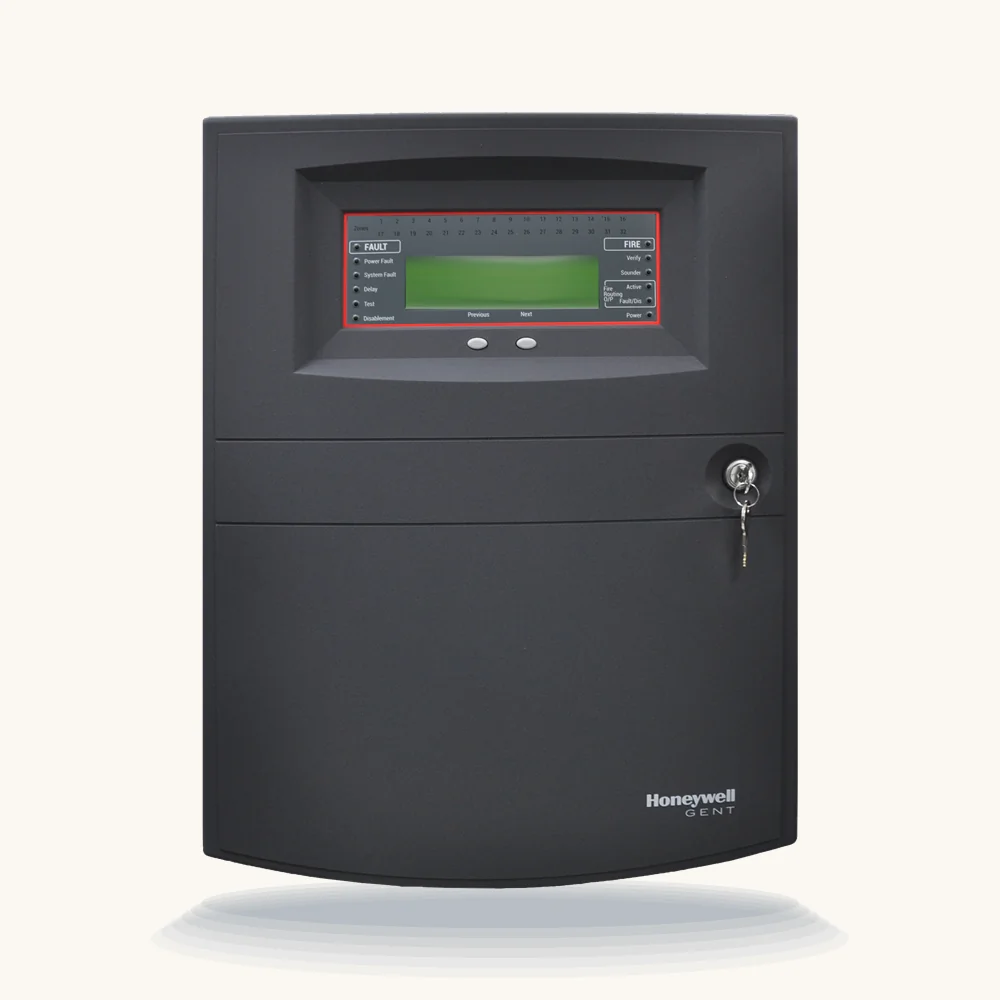
Gent Vigilon Plus control panel.
Record the full model from the panel label. The front view alone does not identify the installed controller, loop cards or software.
Detection: S-Quad, S-Cubed and S4 devices
The S-Quad range includes sensing options and variants that combine detection with alarm outputs. S-Cubed covers sounder and visual alarm devices; the wider Gent range includes manual call points and interface units.
Specify the full device code and the functions required at that location. Check the sensing elements, sounder or voice options, VAD performance and panel/software compatibility for that variant. The Gent product range provides the starting point for a device schedule.
Loop loading and standby: check the full device schedule
Honeywell gives a maximum of 200 addresses per Vigilon loop and 127 per Nano loop. Those figures are address limits: the mix of devices, alarm load, cable length and other design limits still need checking. The manufacturer’s guide lists different permitted quantities for different sounder, VAD and interface arrangements.
Use the Gent loop-load and standby calculations for the proposed installation. Select the panel and battery arrangement from that calculation and the manufacturer’s instructions. An address count alone does not establish how many sounders or VADs a loop can support, or which battery arrangement will fit.
CLSS cloud connectivity
Gent panels can be connected to Honeywell CLSS (Connected Life Safety Services), a cloud platform that layers live panel event data, remote diagnostics and compliance reporting on top of the physical system. CLSS is an addition to a Gent installation rather than a requirement of it — a Vigilon Plus, Compact Plus or Nano panel functions as a complete standalone fire alarm system with no cloud connection at all, and connectivity is a decision made separately for sites where remote visibility or self-test detection make it worthwhile.
The gateway hardware, connection method, subscription structure and self-test licensing needed for a connected system are covered in full in Gent CLSS explained, which walks through the decisions in order for both Gent and Morley panels.
Planning an upgrade or extension
Start with what is installed. Record the panel model, controller and loop cards, software versions and existing device codes. State which functions the proposed change must add or retain.
Send those details with your enquiry so we can check the equipment and engineering scope. A shared product-family name is not sufficient evidence that a replacement card, panel or detector is compatible.
FAQ
Gent fire alarm systems explained questions.
Can any fire alarm company buy and install Gent equipment?
Trade installers can buy Gent equipment from Midland Fire Direct, an approved Gent System Integrator. Tell us whether you need supply only, design assistance or commissioning. The installation and commissioning arrangements should be agreed for the project; buying equipment does not itself confer System Integrator status.
Is Gent the same company as Honeywell?
Gent is a brand owned by Honeywell, not a separate manufacturer trading alongside it. The panels and detectors are still specified, designed and manufactured under the Gent name, and the closed S4 protocol and dealer structure that made Gent distinctive have carried through under Honeywell ownership.
Can Gent panels be networked with Morley panels on the same site?
No. Gent's S4 protocol and Morley's multiprotocol architecture are separate systems, and a Vigilon network cannot include a Morley DXc, ZXSe or Max panel as a peer node. Honeywell owns both brands, but each is specified, networked and commissioned as its own system — see Morley-IAS for the alternative range.
Does a Gent panel need to be connected to CLSS to work?
No. Vigilon Plus, Compact Plus and Nano panels operate as fully standalone addressable fire alarm systems without any cloud connection, and CLSS is an optional service layered on top for remote diagnostics and reporting. See Gent CLSS explained for what a connected system needs.
What is a Gent S-Quad detector?
S-Quad is a Gent device range with different sensing and alarm-output combinations. Specify the exact code: the sensing elements, sounder or voice options, VAD performance and supported panel/software combination depend on the variant.
How many devices can a Gent loop support?
Honeywell gives a maximum of 200 addresses per Vigilon loop and 127 per Nano loop. Device mix, alarm load, cable length and other design limits must also be checked using the manufacturer’s guidance and loop-load calculation. The address maximum is not a guaranteed capacity for every combination of sounders, VADs and interfaces.
Oliver Marston has worked on Gent fire detection systems since 1996 and is the BAFE SP203-1 approved designer at Midland Fire Direct, a Gent Platinum Partner supplying the fire trade across the UK, where he leads the engineering team. He specifies and commissions systems to BS 5839-1 daily.
Specifying a Gent system?
Tell us the site size, panel count and network layout — we'll return a proper Gent specification as an approved System Integrator.