Flame Detectors — UV, UV/IR & Triple IR (IR3)
Optical flame detection for the fires smoke detectors meet too late — the Honeywell FS20X and FS24X multi-spectrum detectors and the FSL100 series, with the test lamps and mounts to commission them. UK-wide, trade and end-user, quote-only.
Made for the fires smoke detectors meet too late.
A flame detector is an optical fire-detection device that senses the ultraviolet and/or infrared radiation emitted by a flame, giving far faster response than smoke or heat detection in high-risk environments. Smoke has to travel; radiant energy arrives at the speed of light, wherever the fire sits in the space.
One scope note: this page covers optical flame detectors for industrial and hazardous-area fire protection — not the burner or boiler flame-failure sensors that share the name. As a UK flame detector supplier we carry Honeywell's FS20X, FS24X and FSL100 ranges, supplied to order with lead times confirmed at quote.
UV, UV/IR and triple-IR flame detection — what's the difference?
UV
Ultraviolet detectors respond fastest — but UV is easy to fake, with arc welding the classic false source. Suited to indoor, controlled environments; in this range that's the FSL100-UV.
UV/IR
Dual-band confirmation: the detector must see both the ultraviolet and infrared signatures before it alarms, which cuts false trips from welding and lightning-type sources. Our FSL100-UVIR and the FS20X IR2/UV units work this way.
Triple IR (IR3)
An infrared flame detector taken to its logical end: three infrared bands compared against the flicker signature of genuine flame, rejecting hot surfaces and sunlight. Highest false-alarm immunity and the longest outdoor reach — the FSL100-IR3 and the FS24XP units.
For a fuller comparison of how UV, UV/IR and IR3 detectors work and where each one fits, read our flame detector types guide.
Honeywell flame detector range.
| Part code | Sensing | Range | Hazardous-area zone (as listed) | Housing |
|---|---|---|---|---|
| FS20X-211-23-6 | IR2/UV | 60 m | Zone 1 | Red aluminium |
| FS20X-211-24-6 | IR2/UV | 60 m | Zone 1 | Stainless steel |
| FS24XP-AMGXX | Triple IR | — | — | Aluminium (red) |
| FS24XP-SMGXX | Triple IR | — | — | Stainless steel |
| FSL100-IR3 | IR3 | 35 m | Zone 2/22 | Red |
| FSL100-UV | UV | 25 m | Zone 2/22 | Red |
| FSL100-UVIR | UV/IR | 25 m | Zone 2/22 | Red |
Values are our catalogue line listings; blank cells and everything else — outputs, approvals, cable entries — are confirmed on the quote. Full range grid: All flame detector SKUs.
Honeywell FS20X & FS24X flame detectors.
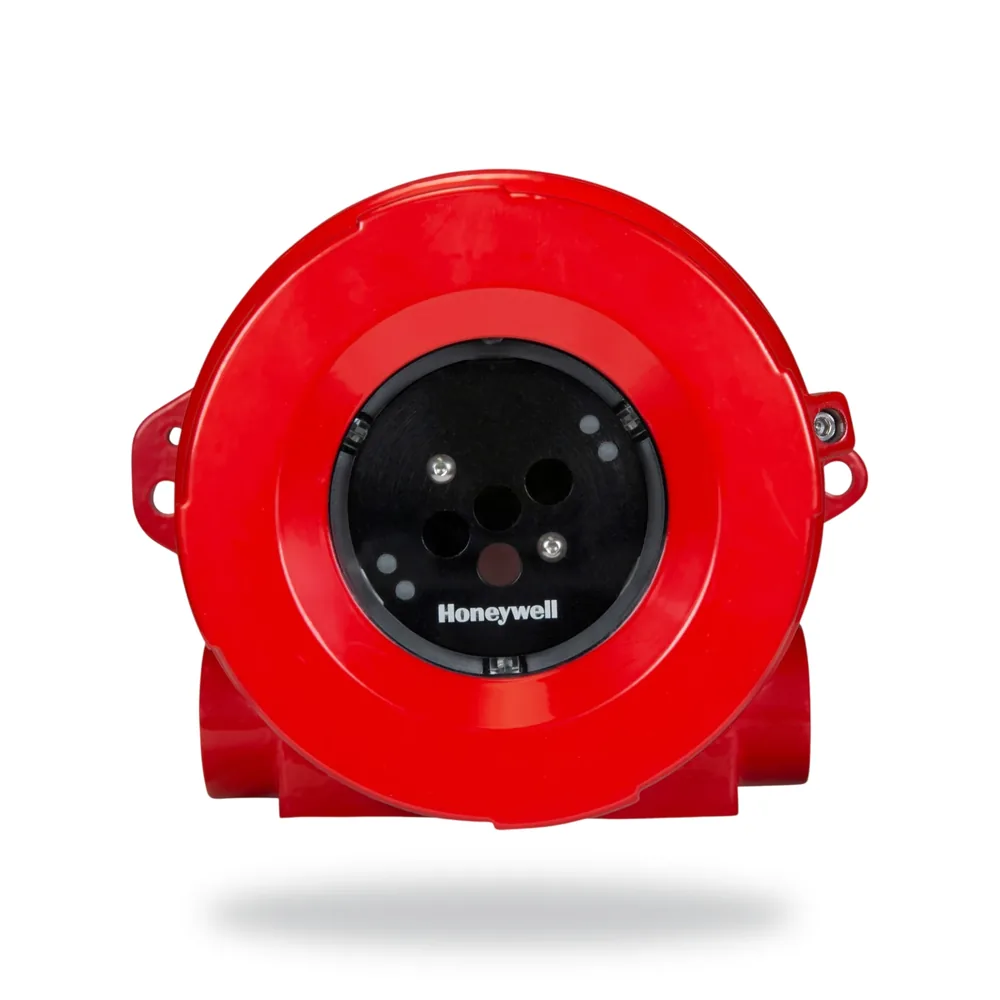
The multi-spectrum family: the 60 m-class FS20X IR2/UV units rated Zone 1 in red-aluminium or stainless housings, and the FS24XP triple-IR units. Supporting spares are supplied to order too — the FSX-A001 diagnostic kit (interface module, RS485/USB cable, PSU and PC software) and the FS20X electronics module.
Honeywell FSL100 series flame detectors.
Compact 25–35 m units for Zone 2/22 applications in UV, UV/IR and IR3 variants, with the FSL100-SM21 swivel mount to set the field of view. Datasheets and installation manuals are Honeywell's official documentation — request the datasheet with your enquiry and we'll supply the current revision reference.
Where flame detectors are used.
Fuel and chemical storage, turbine and generator halls, waste and recycling facilities, aircraft hangars — environments where fires are fast, fuel-rich, or open-air, and smoke detection is too slow or simply unusable. In those risks the seconds a flame detector buys are the whole point: detection while the fire is still small enough to act on.
Flame detector testers, mounts & spares.
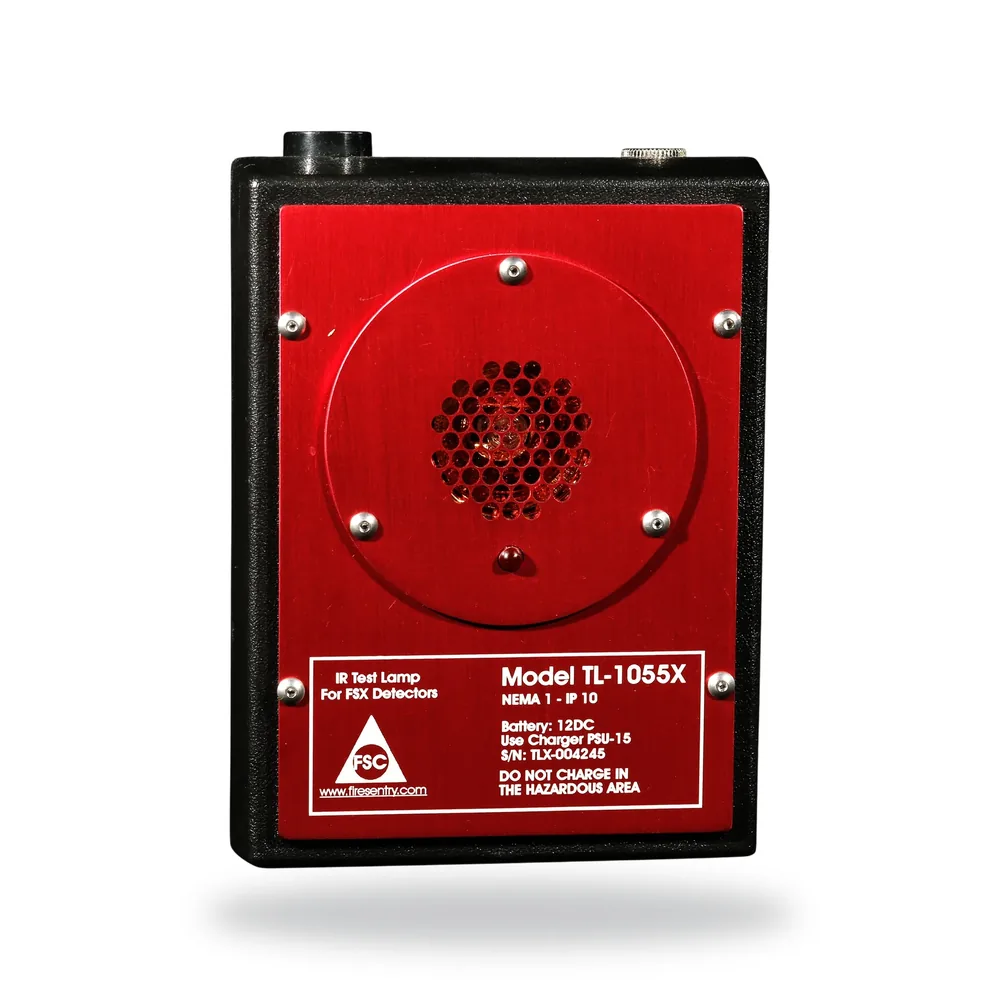
Functional testing uses a broadband test lamp rather than an open flame — the FSL100-TL for the FSL100 series, and the TL-1055 (safe area) and TL-2055 (hazardous area) lamps for FS20X/24X — plus swivel mounts, a sunshield, the FS24XP airshield and diagnostic spares. The full set lives under flame detector testers and accessories.
Common flame-detection questions.
What is a flame detector?
A flame detector is an optical fire-detection device that senses the ultraviolet and/or infrared radiation emitted by a flame. Because it responds to the radiant energy of the fire itself rather than waiting for smoke or heat to reach a sensor, it alarms in seconds — which is why it's specified where fires grow too fast for conventional detection.
What is a flame detector used for?
High-risk, fast-fire environments: fuel and chemical storage, turbine and generator halls, waste and recycling facilities, aircraft hangars — anywhere fires are fuel-rich, fast, or in open and high-airflow spaces where smoke detection is too slow or unusable.
What is the difference between a flame detector and a heat detector?
A flame detector sees the radiant energy of a flame, line-of-sight, in seconds; a heat detector waits for the temperature at the ceiling to rise past a threshold. They are different response classes with different siting rules — flame detection for fast, open or fuel-rich risks, heat detection for slow, smouldering or dirty environments where smoke detection false-alarms.
Should I choose a UV, UV/IR or IR3 flame detector?
UV is the fastest but can be tripped by arc welding; UV/IR requires both signatures before alarm, cutting false trips in busier industrial spaces; triple IR (IR3) has the strongest false-alarm immunity and suits outdoor and long-range duties. In this range, Zone 1 duties point to FS20X and Zone 2/22 to FSL100 — confirm against the site's risk assessment, or call with the application.
How do you test a flame detector?
With a dedicated broadband test lamp — a controlled optical source that exercises the detector end-to-end without an open flame. Test lamps, their bulbs, batteries and chargers, plus swivel mounts and sunshields, are listed under flame detector testers and accessories.
Speccing flame detection?
FS20X, FS24X and FSL100 are supplied to order — send the risk and we'll quote with confirmed lead times.