Guide & tool

Fire Alarm Panel Battery Calculator

Size the standby batteries for a fire alarm panel to BS 5839-1. Enter the panel's quiescent and alarm currents and the standby period, and the calculator returns the minimum capacity and the next stocked battery size up.

Calculator

Battery capacity calculator

Enter the panel's figures and press Calculate.

Calculated per BS 5839-1:2025 Annex E: minimum capacity = 1.25 × [(I₁ × T₁) + D × (I₂ × T₂)], where 1.25 is the ageing factor and D is the alarm de-rating — D = 1 where the battery's 20-hour rate (Cmin/20) is at least the alarm current, otherwise D = 1.75 (or the battery manufacturer's figure). A 24 V panel needs two 12 V batteries of the resulting capacity, wired in series. Always confirm against the panel manufacturer's data and the system design.

The method

How panel standby batteries are sized

A fire alarm panel runs from the mains and keeps its batteries in reserve. If the mains fails, the batteries have to hold the whole system up — in its normal quiescent state for a set standby period, and then at full alarm load for a shorter alarm period. Two figures drive the calculation, and both come from the panel and device data:

Quiescent (standby) current is the current the panel and all its devices draw in normal operation, with nothing in alarm. Alarm-load current is the current with everything active — sounders, strobes and relays all on. Both are given in the panel's commissioning data and the device datasheets, usually in milliamps. The standby period is how long the system must survive on battery — commonly 24 hours, extended to 48 or 72 hours where a fault would not be quickly noticed or attended.

BS 5839-1:2025 Annex E sets the method for valve-regulated lead-acid batteries. The minimum capacity is the standby load over the standby period, plus the alarm load over the alarm period with a de-rating factor for the high discharge current, all multiplied by an ageing factor so the battery still meets the requirement near the end of its life:

Cmin = 1.25 × [ (I₁ × T₁) + D × (I₂ × T₂) ]

The 1.25 is the ageing factor. D is the alarm de-rating: where the battery's 20-hour discharge rate (Cmin/20) is at least the alarm current, no de-rating is needed and D = 1; where the alarm current is higher — the usual case, because sounders and beacons draw heavily — D = 1.75, or the figure the battery manufacturer gives. The calculator applies this test for you.

Worked example. A panel drawing 0.25 A quiescent and 0.75 A in alarm, over a 24-hour standby and a 30-minute (0.5 hour) alarm. Here the alarm current is higher than the battery's 20-hour rate, so D = 1.75: the standby part is 0.25 × 24 = 6 Ah; the alarm part is 1.75 × (0.75 × 0.5) = 0.656 Ah; the total, with the 1.25 ageing factor, is 1.25 × (6 + 0.656) = 8.32 Ah. You then round up to the next available battery size — here 12 Ah — and fit two of them in series for a 24 V panel.

The battery

The battery behind these sizes: 12V VRLA

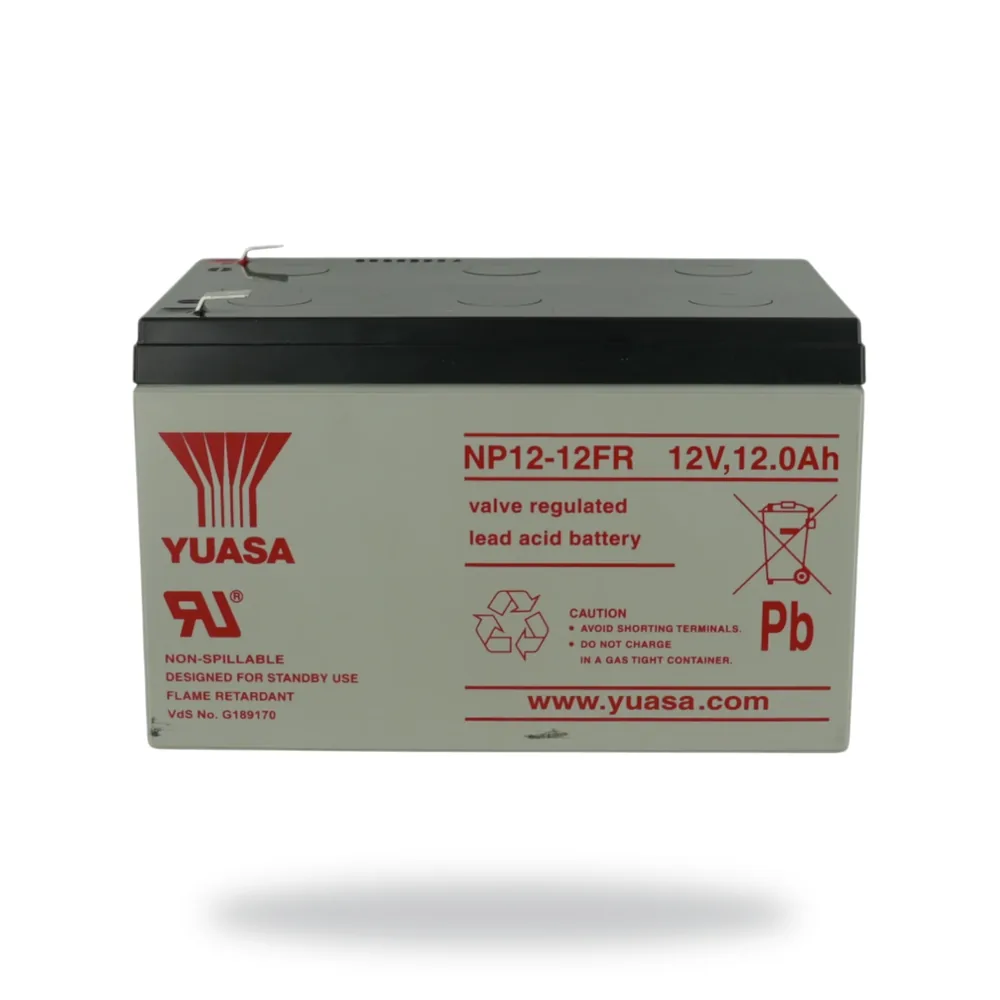
Fire alarm panels use sealed lead-acid (VRLA) standby batteries at 12 V, in a flame-retardant case as BS 5839-1 requires. A 24 V panel takes two of them wired in series; the pair shares the amp-hour capacity from the calculation. We stock the Yuasa NP flame-retardant range across the sizes a fire alarm system usually calls for — these ship by courier, as flame-retardant lead-acid batteries can't go by standard post.

Stocked 12V flame-retardant battery sizes

CapacitySKUTypical use
1.2 AhNP1.2-12Small panels, ancillary standby
2.8 AhNP2.8-12Morley Horizon and similar
7 AhNP7-12Common small–mid panels (Horizon, DXc, ZXSe)
12 AhNP12-12Mid-size systems (ZXSe)
17 AhNP17-12Larger systems (DXc, ZXSe)
24 AhNP24-12High-load or extended-standby systems
38 AhNP38-12Large systems, long standby periods
65 AhNP65-12The largest systems and standby demands

See the full flame-retardant batteries range for the complete list and fitment notes.

In service

Replacement and disposal

Standby batteries lose capacity as they age, which is why the calculation carries an ageing factor and why battery condition is part of periodic servicing — see the commercial fire alarm testing guide. When a battery no longer holds the required capacity it is replaced like-for-like on capacity and voltage, always as a matched pair on a 24 V panel. Old sealed lead-acid batteries are recycled through a lead-acid battery waste stream, not general waste. Follow the panel manufacturer's guidance on replacement intervals.

FAQ

Fire alarm battery questions.

How long should a fire alarm system run on standby batteries?

BS 5839-1 sets a standby period the batteries must cover if the mains fails — commonly 24 hours, extended to 48 or 72 hours where a fault would not be quickly noticed or attended, such as an unmonitored building. On top of that the batteries must drive the system at full alarm load for the alarm period, typically 30 minutes. Both periods feed the capacity calculation, so a longer standby period means a larger battery. We stock the sizes in the flame-retardant batteries range.

How do I calculate the battery size for a fire alarm panel?

Multiply the panel's quiescent current by the standby period, add the alarm current multiplied by the alarm period and an alarm de-rating factor, then apply the 1.25 ageing factor. BS 5839-1:2025 Annex E gives the method — minimum capacity = 1.25 × [(standby current × standby time) + D × (alarm current × alarm time)], where D is 1 if the battery's 20-hour rate is at least the alarm current and otherwise 1.75 — and you round up to the next available size. The calculator at the top of this page does it for you.

Can I use any 12V battery in a fire alarm panel?

No. A fire alarm panel needs a sealed lead-acid (VRLA) standby battery of the correct capacity in a flame-retardant case, to BS 5839-1. A general-purpose or vehicle battery is the wrong chemistry and case and should not be used. Match the amp-hour capacity to the calculated figure and the panel manufacturer's specification.

What happens if fire alarm panel batteries are undersized?

An undersized battery cannot hold the system up for the required standby and alarm periods when the mains fails. The panel runs from the mains and keeps the battery in reserve; on a mains failure an undersized battery is exhausted early, leaving the system without power. Sizing to BS 5839-1 with the ageing factor guards against this across the battery's life.

Know the size you need?

Send the capacity or the panel model — we'll match the flame-retardant battery and quote the stocked items same-day.